VeriFish featured by CORDIS for bringing greater clarity to seafood sustainability

VeriFish has been featured by CORDIS, the European Commission’s platform for communicating the results of EU-funded research and innovation.

The article, titled “Bringing clarity to seafood sustainability and eco-label claims,” highlights how VeriFish has helped address one of the central challenges facing the seafood sector: how to communicate sustainability information in a way that is scientifically robust, transparent and understandable.

Seafood is among the most widely traded food products globally, yet consumers and other actors across the value chain are often confronted with fragmented information, multiple eco-labels and sustainability claims that can be difficult to compare or verify.

VeriFish was developed to respond to this challenge.

A science-based approach to seafood sustainability

At the core of the project is the VeriFish Indicator Framework, a multi-dimensional system that assesses seafood sustainability across three complementary pillars:

  • Environmental performance
  • Socio-economic conditions
  • Nutrition and health

The framework integrates 84 indicators and reflects the fact that sustainability cannot be reduced to a single score or claim. Environmental impacts, nutritional characteristics and socio-economic conditions are distinct dimensions, each requiring different evidence, data sources and interpretation.

The environmental pillar addresses issues such as habitat pressure, climate impacts, waste and effluents, water use and animal welfare. The nutrition and health pillar uses species-specific food composition data to provide transparent information about nutrient content. The socio-economic pillar considers conditions that influence responsible production, including labour risks, occupational health and safety, anti-discrimination protections and regulatory frameworks.

Together, these dimensions provide a more complete picture of seafood sustainability.

Making complex data usable

The CORDIS article also highlights the VeriFish Knowledge Base, which consolidates data from recognised international sources into a unified and quality-checked structure.

The framework follows FAIR data principles, ensuring that information is findable, accessible, interoperable and reusable. By connecting data from sources including the Food and Agriculture Organization of the United Nations, the World Health Organization and recognised food classification systems, VeriFish supports more consistent comparisons across species, production systems and regions.

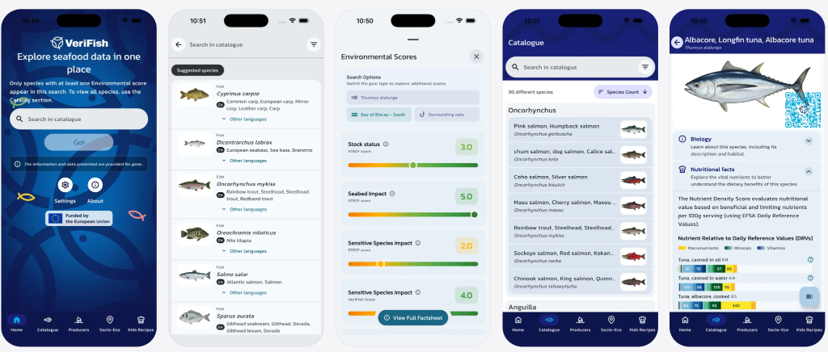
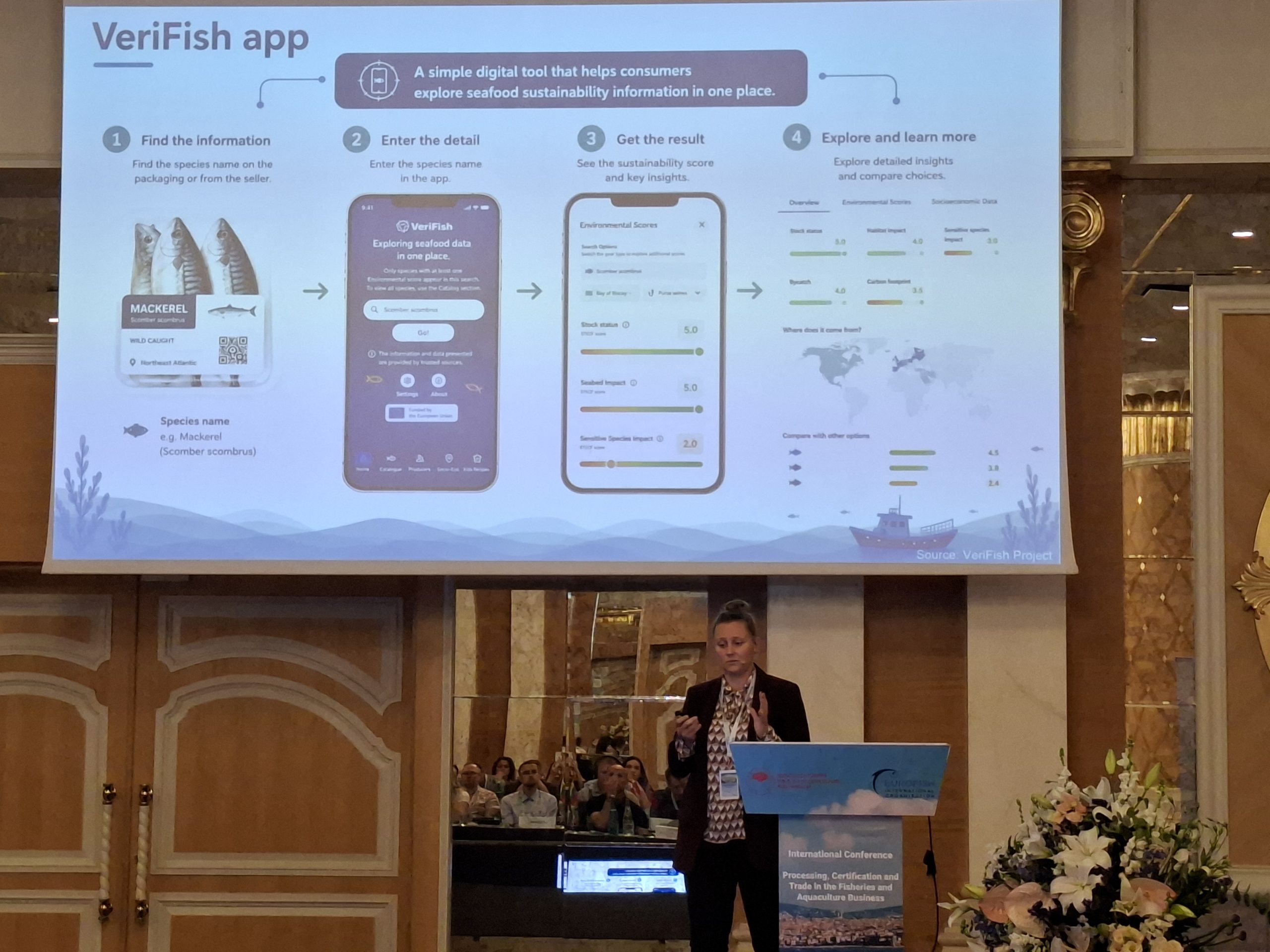
This information is made accessible through the VeriFish web and mobile app, developed as a working prototype during the project.

The app translates complex sustainability data into a format designed for consumers, producers, buyers and policymakers. Users can explore species factsheets and sustainability information, while fishers and producers can provide verified information about their practices. Personalised QR codes can also be used to make relevant information available at the point of purchase.

In this way, the app helps bridge the gap between the availability of seafood sustainability data and its practical use.

Supporting credible communication

Beyond the indicator framework and app, VeriFish has also produced a CEN Workshop Agreement containing good practice recommendations for organisations developing seafood communication campaigns.

The recommendations are designed to help public and private actors communicate more effectively with consumer groups while making efficient use of available resources. In the longer term, this work aims to support the production, availability and consumption of more sustainable seafood.

The project also explored a range of alternative communication formats, including a cookbook, an educational card game, posters, videos and practical guidelines.

These outputs reflect an important lesson from the project: people are not necessarily tired of sustainability information. They are tired of information that is vague, abstract or difficult to apply.

When sustainability communication is credible, practical and easy to understand, consumers and stakeholders are willing to engage with it.

Recognition of the VeriFish approach

The CORDIS feature provides important recognition of the work carried out by the VeriFish consortium and of the project’s contribution to more transparent seafood systems.

By combining science-based indicators, structured data, digital tools and practical communication resources, VeriFish has created a foundation for clearer and more reliable seafood sustainability communication.

The project’s results can support consumers in making informed choices, help producers and retailers communicate more responsibly, and provide policymakers and organisations with stronger tools for promoting sustainable fisheries and aquaculture.

The full CORDIS article is available online under the title “Bringing clarity to seafood sustainability and eco-label claims.”: https://cordis.europa.eu/article/id/465731-bringing-clarity-to-seafood-sustainability-and-eco-label-claims?WT.mc_id=exp
David Bassett

Employed by EATiP since 2017, David is responsible for the day-to-day management and direction of this European wide multi-actor ETP. 

Working in the aquaculture industry since 2005, including a decade as the executive of a UK producer association, he has been active in numerous projects from the sixth Framework Programme. Among other roles, David has served as a director of the Scottish Aquaculture Research Forum and served on the Technical Advisory Group of the Aquaculture Stewardship Council (ASC TAG) alongside being invited as a guest lecturer at the Institute of Aquaculture, University of Stirling (UK).  

In addition to working on multiple Horizon Europe projects David is one of the Technical Experts assisting with the implementation of the EU Aquaculture Assistance Mechanism in addition to chairing the research focus group of the Aquaculture Advisory Council (AAC) and sitting on the Standing Committee on Agricultural Research – Fish Committee (SCAR-Fish). 

For further information on EATiP please see www.eatip.eu 

Paul Bulcock

Paul Bulcock is responsible for developing and maintaining aquaculture information in SFP’s systems (e.g., FishSource, AIP Directory, Metrics). He also supports development and implementation of aquaculture strategy through research and analysis.

Paul has extensive program support and aquaculture research experience (particularly in Southeast Asia), having worked for the Network of Aquaculture Centers in Asia-Pacific (NACA) and DFID’s Aquaculture and Fish Genetics Research Programme (AFGRP) at the Institute of Aquaculture, in Stirling, UK. He has an MSc in aquaculture from the University of Stirling and a BSc in marine and fisheries zoology from the University of Aberdeen.

Paul is based in the UK, in Glasgow, Scotland.

Fabio Grati

A fishery biologist presently employed at the National Research Council, Institute for Marine Biological Resources and Biotechnology (Ancona, Italy), he brings to the table more than thirty years of expertise in marine environmental conservation and sustainable resource management. Over the course of his career, he has overseen and participated in numerous international projects focused on understanding and mitigating anthropic impacts on marine ecosystems. Since 2019, he holds a membership in the Scientific, Technical and Economic Committee for Fisheries (STECF) under the European Commission. Within this role, he has chaired two STECF Expert Working Groups (EWG 22-12 and EWG 23-18), where he led efforts to establish scientifically robust yet accessible criteria and indicators for assessing the sustainability of fisheries products.

Andrea Fabris

Andrea Fabris born 11.08.1968, Italian, has a Veterinary Medicine full graduation achieved at the University of Parma. He has also a Specialization in “Farming, Hygiene, Pathology of Aquatic Species and Control of Derivative Products ” achieved at Udine University and a Specialization in “Animal Feeding” obtained at Bologna University.

Actually (from May 2016) he is Director of Associazione Piscicoltori Italiani (API – Italian Fish Farmers Association). At National level behalf of API he is member of some working groups at the General Direction for Fisheries and Aquaculture of Italian Ministry of Agriculture and Italian Ministry of Health regarding aquaculture EU rules and their implementation at national and regional level, and member of Exotic Species Aquaculture Committee – Italian Ministry of Agriculture. Lecturer on in training /courses organized by Ministry of Health, Universities and Local Veterinary Authorities; member of Board of Directors of SIPI (Italian Society of Fish Pathology).

He is also involved at international level with the Federation of European Aquaculture Producers (FEAP) as Chairman of FEAP Fish Health and Welfare Commission. Andrea is part of the FVE (Federation of Veterinarians Europe) Aquaculture Working Group, and of FishMedPlus Coalition, and from the beginning member of Aquaculture Advisory Council (AAC) where is actually Chair of WG1 – Finfish.

He published as an author or co-author about 30 articles on international and national scientific journals concerning Fish pathology and Aquaculture and more than 60 issues on divulgative (fishermen and aquaculture producers associations) publications

Anne Marie Cooper

Anne shapes global sustainable fisheries and aquaculture policies through her work at the science-policy interface. Driven by a commitment to improving human lives and aquatic ecosystems, she serves as the Professional Officer for Fisheries and Aquaculture Advice at the International Council for the Exploration of the Sea (ICES) in Copenhagen, Denmark. Anne leads ICES’ efforts in developing and applying methods to provide scientific advice on data-limited fish and shellfish stocks in the Northeast Atlantic, covering over 60% of ICES stocks. She also heads the development of ICES’
advisory framework for sustainable aquaculture. Before joining ICES, Anne advised on national fisheries, aquaculture, climate, and marine science policy in the US Senate, House of Representatives, and NOAA. She holds a Ph.D. in Conservation Biology and Development Studies and Social Change Theory and an M.Sc. in Fisheries Science from the University of Minnesota.

Pedro Reis Santos

Pedro Reis Santos is Secretary General of the Market Advisory Council (MAC), a stakeholder-led advisory body to the European Commission and to the Member States on matters relevant for the EU market of fishery and aquaculture products, as foreseen by the Common Fisheries Policy Regulation.

Before his appointment, in July 2019, as Secretary General, Mr Reis Santos worked as a consultant for a Brussels-based business intelligence service monitoring EU developments on fisheries, agriculture, food, animal welfare, alcohol and tobacco policy. Prior to that, he was a trainee at the Fisheries Unit of the Council of the European Union and a trainee at the Control Unit of the Portuguese Fisheries Authority.

Mr Reis Santos holds a Bachelor’s degree in Law and a Master’s degree in International Law and International Relations from the University of Lisbon with a thesis titled “Marine Protected Areas beyond National Jurisdiction”. Besides his first language, Portuguese, he speaks English and Spanish

Irene Kranendonk

Irene Kranendonk is the Impact Manager at Fish Tales and a board member of the Fish Tales Foundation. Her work focuses on developing and guiding Fish Tales’ sourcing criteria including management of the environmental and social certification schemes. With the Fish Tales Foundation and local partner organizations, she drives social and environmental improvements in small scale fisheries. Irene holds a master’s degree from Wageningen University in Aquaculture and Marine Resource Management and is specialized in the field of fisheries ecology. In a previous role, Irene was sustainable seafood assessor for the Dutch seafood rating scheme the VISwijzer.