How can seafood businesses communicate sustainability in a way that consumers understand, trust, and use?
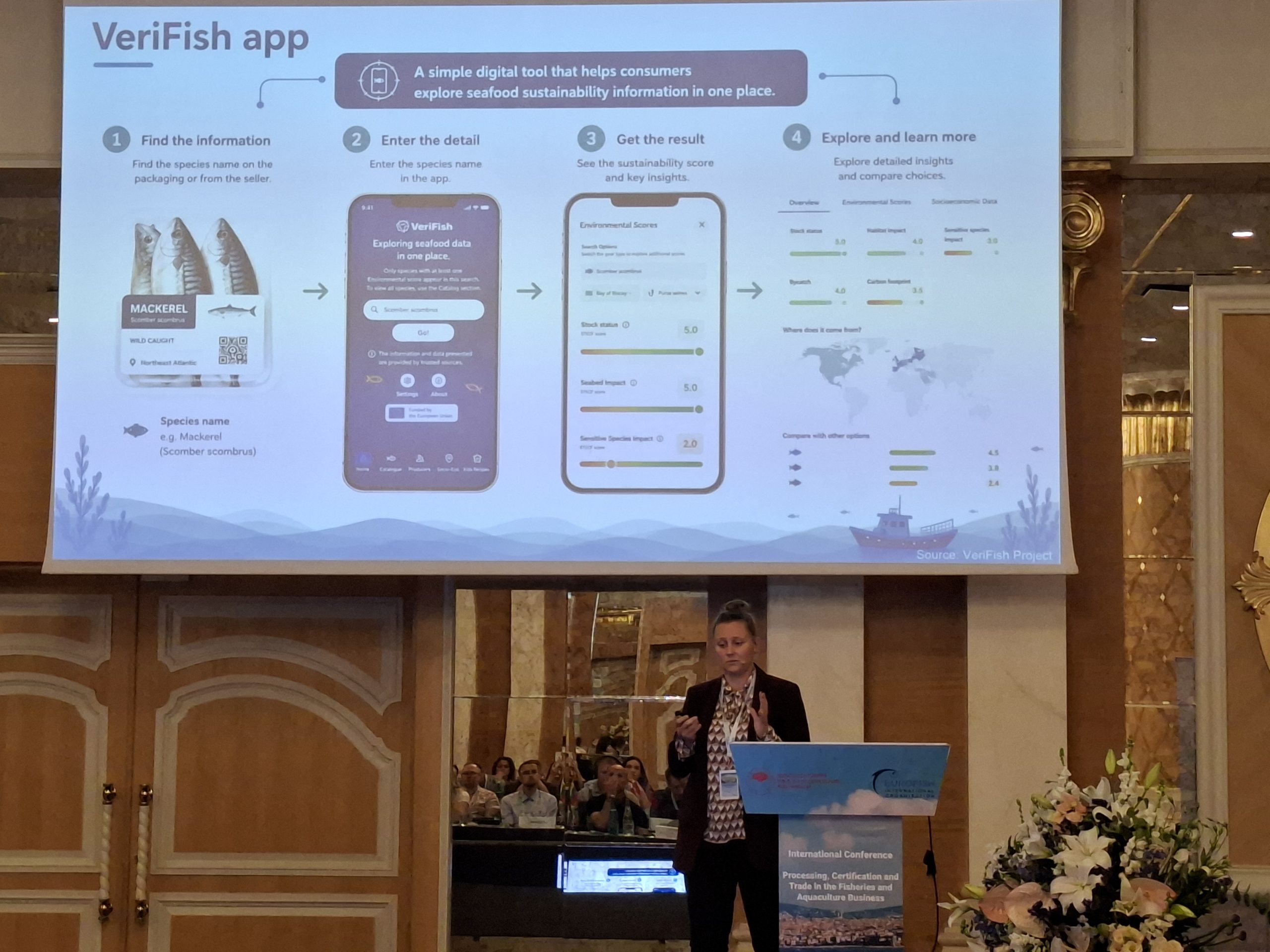
This question was at the heart of a presentation delivered by Francesca Barazzetta at the Eurofish Conference “Processing, Certification and Trade in the Fisheries and Aquaculture Business”, held in Istanbul, Türkiye, on 10 June 2026.
The presentation explored one of the most important challenges facing the seafood sector today: providing consumers with sustainability information that is both meaningful and credible in an increasingly complex marketplace.
A growing demand for trustworthy information
Consumers are increasingly interested in where their food comes from, how it is produced, and what impact it has on the environment and society. At the same time, seafood supply chains are among the most complex food systems in the world, involving thousands of species, multiple countries, diverse production methods, and long international value chains.
This complexity creates significant communication challenges. While consumers want transparent information, they are often faced with a multitude of labels, claims, certifications, and sustainability messages that can be difficult to compare or verify.
The presentation highlighted that effective sustainability communication is not about providing more information. It is about providing information that is clear, evidence-based, transparent, and relevant to the audience.
VeriFish as a practical example
As part of the discussion, the VeriFish project was presented as an example of how sustainability information can be organised and communicated in a more structured way.
The project has developed a framework that brings together three interconnected dimensions of seafood sustainability:
- Environmental
- Socio-Economic
- Nutrition & Health
Rather than focusing on a single aspect of sustainability, VeriFish recognises that seafood products have multiple impacts and benefits that should be understood together.
The presentation showcased how these dimensions are integrated through the VeriFish indicator framework, the web application, the communication guidelines, and a range of educational and outreach materials developed during the project.
From data to understanding
A key message of the presentation was that sustainability communication must be built on verifiable evidence.
Consumers increasingly expect information that can be traced back to reliable sources. Businesses, retailers, and producers therefore need communication approaches that are not only engaging but also transparent and defensible.
The VeriFish framework supports this by encouraging communication based on documented data, clearly defined scopes, understandable language, and accessible proof.
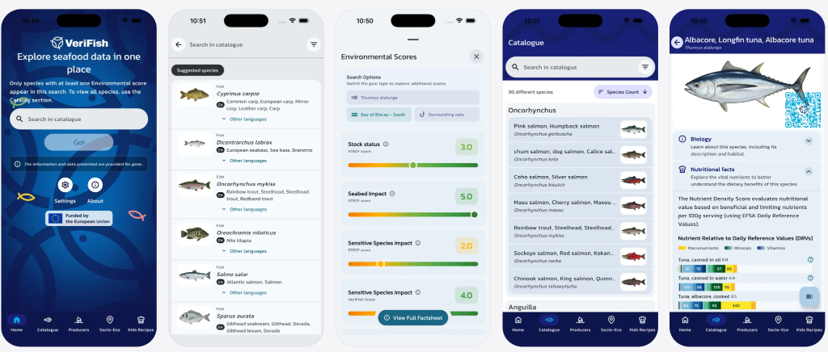
Digital tools, particularly QR-code-based solutions, were highlighted as an increasingly important mechanism for connecting consumers with detailed information at the point of purchase. Through the VeriFish web app, users can explore sustainability indicators, species information, nutritional data, and other relevant information in a format designed to support informed decision-making.
Different audiences, different messages
Another important theme of the presentation was the need to adapt communication to different audiences.
Consumers do not all seek the same information. Some prioritise environmental considerations, others focus on health and nutrition, while many balance sustainability concerns with affordability, convenience, and familiarity.
Effective communication therefore requires selecting the right channels, formats, and messages for each target audience.
Examples discussed included social media campaigns, storytelling approaches, educational materials, digital platforms, and interactive tools. The objective is not simply to inform, but to engage and motivate people to better understand seafood and its role within sustainable food systems.
Building trust through transparency
Ultimately, trust remains the foundation of sustainability communication.
Consumers are more likely to engage with sustainability information when it is clear, consistent, and verifiable. For businesses and organisations, this means ensuring that claims are supported by evidence, limitations are acknowledged, and information is accessible.
The VeriFish project has worked to support this objective by providing tools and recommendations that help translate complex sustainability data into information that can be understood by both professionals and the public.
Looking ahead
The discussions in Istanbul demonstrated that seafood sustainability communication continues to evolve rapidly. Digital technologies, data-driven approaches, and changing consumer expectations are creating new opportunities for the sector.
As the VeriFish project reaches its conclusion, its framework, web app, guidelines, and communication materials remain available as resources for stakeholders seeking to communicate seafood sustainability in a transparent, evidence-based, and meaningful way.
Because good sustainability communication is not about saying more.
It is about saying what can be proven, in a way that people can understand and use.